In the AI hype cycle, recent headlines have screamed how you can now one shot an app. What does that mean? By describing the desired framework and methodology in a prompt, you can have Claude create the whole application in one sitting. While creating code that can execute end to end is the goal now with Claude, Codex, and Gemini among others, the truth is one shot is just one step in the app development to deployment process.
With AI, the way to get the best out of AI, is to have it describe the work for itself. With Claude we actually want Claude to come up with its main Claude.md file that will have the project structure and problem description that Claude will use to compile the code. Since an application is really multiple layers and many pieces of logic or functions, we want to break down the problem into many sub problems that allow more specialized prompting to bring about a coded solution. An added benefit of these smaller sub problems is that they will require less context, use less tokens, and lead to quicker bug fixing when debugging.
To recap, we prompt our app, and describe what we want to do. Programmers have the background to think in systems and components and will describe the prompt so that Claude will go ahead and start to break out the work into separate Md files. These MD files will then be handed off to individual agents to code. So, how many MD files might a production application have?
Best to ask Claude! Here is the way Claude typically would structure an application based on conventional programming methods.
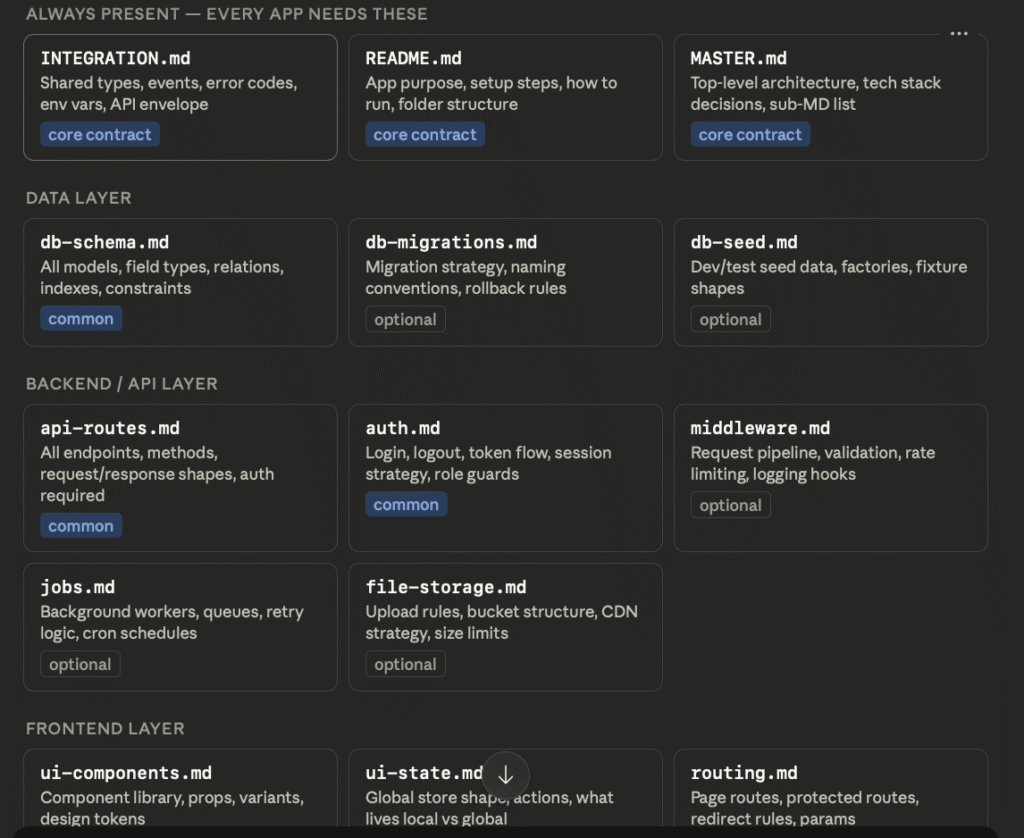
This is a Claude generated diagram of the md files that it would look to build out for a production app. Each md file here would be generated from a top level Claude prompt with subsections describing the work the programming agent will execute. It is infeasible to properly describe the app capabilities in a simple Claude file so this framework is just a start to going into depth of the product requirements.
User interacting apps today have a front end with a GUI, a middle layer that translates user interactions from different front platforms into a common data layer. This data layer is then processed and acted upon in the middle layer, with resulting outputs going to the database layer as well as back to the GUI layer. We see this framework represented in the Claude diagram above.
Claude has created multiple MD files at each layer so we can get into the weeds of the details required and how to process the information, and how to validate the application output. This breakout of the application, like chapters of a book, provide clean breaks on responsibilities similar to having separate programmers with their distinct ownership of programming areas of a complex software project. With each MD file described, we can go ahead and now run agents to generate the code, with the AI validating its output using the QA functions you described in the MD file. File by file, this is the new AI programming method. From a high-level overview to low level implementation details, the ability to write what you’re thinking is the limiter. Coding with AI means technical knowledge is no longer the barrier.