Companies are rolling out AI for all users to drive efficiency. Companies have gone from searches on Google which were free, to now paying for AI answers. Either through monthly subscriptions or through the API, each question an employee asks AI comes with a cost.
The biggest noise around AI has been around coding by using Codex or Claude. For non-technical workers, AI can still immensely improve their efficiency in parts of their role they are not skilled at. Look at this post from LinkedIn.
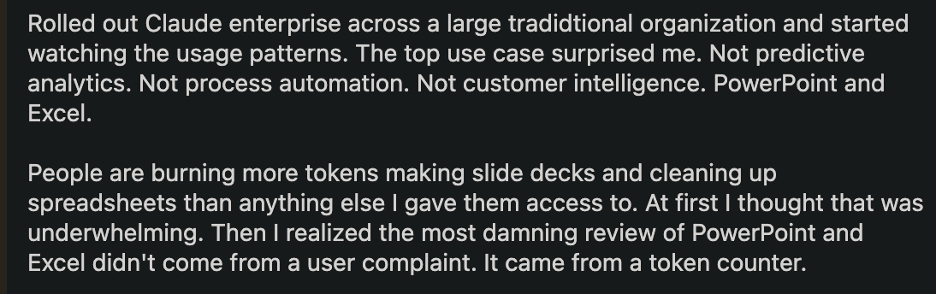
AI to replace PowerPoint decks
Office tools like PowerPoint and Excel have been around for decades. Workers would power through the formatting and adjusting slide decks to make the story and imagery come to life. Now, AI can just do the work. According to Gamma, workers can save four hours per presentation using AI.
Beyond the time savings, worker can retain the satisfaction of working on parts of their role they enjoy and drive employee engagement. For some departments like marketing, working inside PowerPoint is their role. Their adjustments and design are the taste that drive the company format and can not be replaced with AI. For others, PowerPoint is the tax to get ideas noticed on the corporate ladder.
Excel and AI determine skills
Now let’s compare AI use of PowerPoint, to Excel. Excel is a core function of many roles. From the data and analysis a skilled employee can create deep insights and automate workflows with the spreadsheets. But, not everyone has deep Excel skills.
Some people click in Excel, others use keyboard shortcuts. An individual could use Excel and not show if they were a basic user or power user. Now with AI able to look at who is asking and what question they are asking, firms have an opportunity to differentiate skills.
Firms can dig into the type of questions employees ask. Types of questions can range from high level project decisions where employees outsource their thinking to AI. It can take the next level of employees using AI to help do parts of the work they do not understand. This works when people have an understanding of the task, and looking to vet different ideas quicker. The lowest level is someone who barely understand excel and now is asking AI about formulas and low level implementation.
AI is tool, but not for all cases
With the cost of AI tokens, firms are keeping an eye on spend. Employee monitoring of tools is one component of managing costs. Managing the types of queries that AI is asked is another. Education about costs and tools can help manage costs. Another is a reminder that Google and the web are still capable answering platforms. And the last, is that continual employee education can help improve skills and output over time. AI assisted learning to scale knowledge and improve efficiency.